

Theoretically, there is a version of The Odyssey that should work perfectly for Christopher Nolan. The source material is already fractured and recursive, told through memory, rumor and delayed recognition. It is concerned with weighty themes like guilt, hubris, and what it means to become and remain a hero. This should be Nolan’s wheelhouse.
Swing and a miss.
Christopher Nolan’s The Odyssey never quite becomes special. It is often handsome, sometimes powerful, and occasionally thrilling in the specific way that only big mythic cinema can be. But at the end, I felt as though I had watched a mediocre Shakespeare adaptation. The source survived the re-imagining, and because the source is so strong, the ultimate result remains watchable and engaging. But too much has been flattened, simplified, rearranged, or over-managed for the film itself to become great.
Nolan gives the film a proper visual scale, and some of the cinematography is genuinely strong. I enjoyed a long shot through Penelope’s weaving of the burial shroud especially. Some of more expansive shots of the sea, the landscapes, and even of Troy and Ithaca are magnificent. The Odyssey needs the grandeur of distance, the weight of ocean, the terror of divine attention. On that level, the film often delivers. It looks expensive in the right way, not merely as spectacle but as atmosphere. Sure, there are some weaker shots and a few bits of dodgy CGI composites going around the internet, but for the most part this is a fine film to look at.

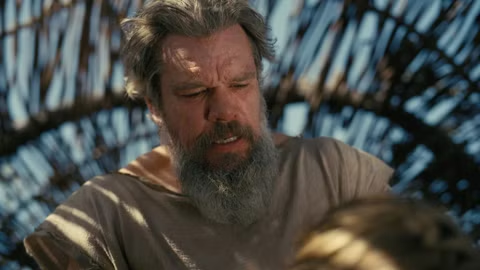
The performances help, too. Matt Damon gives Odysseus a weathered physicality that works better than the writing around him, though the character that he and Nolan have created emphasizes a peculiar guilt and post-traumatic stress that feels out of place for the Greek world surrounding him. Much better is the insight he expressed at the end of the film: we may have changed the world for the worse, and there may not be a home to return to. Robert Pattinson is strong in all of his scenes, properly oily and sanctimonious throughout. But the standout for me was John Leguizamo, who gives the film a pulse and the true sense of tradition and gravitas that it badly needs.

There are also a few places where Nolan remembers that he is adapting Greek myth and not just plotting a prestige puzzle box. His use of dramatic irony is probably the film’s best intellectual choice, though it is hard to say whether that’s Nolan making a choice or simply not ruining one already made by Homer. The Greeks knew exactly how to torture an audience with knowledge, hide a character in a disguise, and really draw out the drama. Nolan taps into that tradition well enough that the film occasionally achieves the properly classical sensation of watching people march, proudly or desperately, toward meanings and outcomes far larger than themselves.
But then there is the Nolan of it all. The man never read a nonlinear story he didn’t think needed another flashback. Fortunately, The Odyssey practically invites this treatment. The poem is already a story about stories, about Odysseus recounting his own suffering, about a homecoming that exists in memory, prophecy, rumor, and delayed recognition. If ever there were a source text ready for the same man who made Memento, The Prestige, Inception, Interstellar, and Tenet (Jesus, remember that one!), it is The Odyssey.
So why does the film so structurally labored?

The film keeps returning to the sack of Troy, reusing shots and fragments until the technique begins to feel less like memory and more like a crutch. At first, the recurrence has power. Troy is the wound behind the journey, the original sin, the great violence from which Odysseus cannot simply sail away. But Nolan keeps going back to it, and then going back again, and the effect diminishes each time. A haunting image becomes a repeated cue. A structural motif becomes a habit.
This is the larger problem with the movie: Nolan’s tricks do not feel freshly discovered by the material. They feel imposed upon it. Instead of unlocking Homer, they often compress him.
The dialogue has a similar issue. It is too stilted, too declarative, too eager to reduce mythic complexity into clean statements. The repeated invocation of “Zeus’s Law” is the clearest offender. I understand the purpose. The film is trying to dramatize xenia, the sacred guest-host bond protected by Zeus Xenios. Hospitality and obligation, guest-right, divine order, civilization itself, these are not incidental ideas in The Odyssey. But “Zeus’s Law” is such a clumsy modern compression that the phrase starts to sound like an in-universe legal statute. Say anything often enough and it stops sounding profound and more like a suit somewhere underlined the theme in the script notes.
Worse, the film invokes “Zeus’s Law” constantly and then fumbles where it should matter most. The encounter with the cyclops is interesting, in part, because the cyclops completely inverts the tradition: rather than feed guests, he eats them. But, in addition, Odysseus and his crew breach the rule as well: they make themselves at home and feast on the goat cheese, casting them as poor guests in the vein of the suitors awaiting Odysseus back in Ithaca. The episode is not just “monster bad, hero clever.” It is a dense little knot of violated customs, reciprocal offenses, cunning, savagery, pride, and consequence. Nolan sands almost all of that away.
He also smooths over the “no one” pun and the resulting act of hubris when Odysseus reveals his true name to the Cyclops, allowing the monster to call down a curse from Poseidon. In the film, this takes a much cruder form. Odysseus shoots an arrow at the Cyclops while running away and offers a milquetoast justification: “he ate some of us! I had to hurt him, too!” How boring, how basic, how stupid.
That simplification weakens the whole film because Nolan clearly wants The Odyssey to bear the weight of a major civilizational statement. This is the film’s most interesting interpretation, and the place where I wish it had trusted itself more. Nolan seems to be reading Odysseus and Agamemnon not merely as men returning from war, but as agents of collapse: people of the sea, destroyers of cities, men who helped shatter the world they now hope to re-enter. They are not only victims of a broken age. They helped break it. Troy was not an adventure. Troy was an apocalypse with better poetry.
There is a great film in that idea. A terrifying one, even. Civilization can fall. Heroes can become raiders. The songs we inherit may be beautiful lies told about men who left ruin behind them. When Odysseus suggests near the end that they may have changed the world for the worse, Nolan briefly finds the sharper edge of his own adaptation. The long road home is not only a test of endurance. It is a reckoning with the possibility that home itself has been made impossible by the very heroic age that produced him.
But the film keeps sanding the material down at precisely the points where it ought to cut deepest. It simplifies xenia, dulls the Cyclops episode, flattens Odysseus’s hubris, and then asks the audience to accept the remaining arrangement as tragic profundity. The big insights do not emerge from the drama. They arrive already labeled, stitched together with Cliff Notes connective tissue and announced with expensive solemnity.
Nolan’s film understands some of this, but not enough. Or perhaps it understands it and then explains it until the magic leaks out. What remains is a visually impressive, well-acted, sometimes compelling adaptation that falls far short of the material it has chosen. That is not a crime. Plenty of films fall short of Homer. Most things do.
But The Odyssey should feel inexhaustible. This one feels managed, compressed, and overfamiliar. Nolan found a way home. He just lost too much on the voyage.